The Zelda Timeline: A Research Paper
A research-backed account of the official Legend of Zelda timeline, produced by a multi-source, adversarially-verified research pass. Findings below are cited to their sources; confidence and caveats are noted throughout, especially for the four titles Nintendo has never officially placed on any published chart.
1. The two official charts
Nintendo has published exactly two series-spanning timeline documents: the 25th-anniversary book Hyrule Historia (2011, compiled under producer Eiji Aonuma), and a revised chart in the Zelda Encyclopedia (2017). No official chart has been published since — meaning every Switch-era title, including Breath of the Wild's two direct sequels and both Hyrule Warriors spin-offs, exists entirely outside any Nintendo-drawn map. Everything below the fold on the newest titles is therefore reconstructed from developer interviews and critical/community consensus, not a chart Nintendo has actually printed.
2. The shared trunk
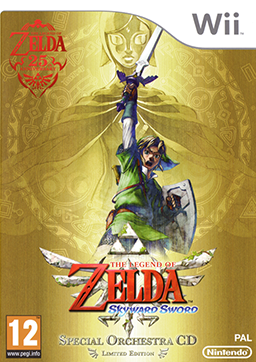 Skyward Sword (2011) — chronologically first in the entire series, official chart included.
Before the timeline splits, all three branches share one linear history: Skyward Sword (the mythic origin point, where the goddess Hylia's fight against the demon Demise sets the entire series' reincarnation cycle in motion) → The Minish Cap → Four Swords → Ocarina of Time. Ocarina of Time is the single fork point of the entire official timeline — not because of anything unusual about the game itself, but because of its ending.
 Ocarina of Time (1998) — the single fork point of the entire official timeline.
3. The three-way split
Ocarina of Time can be read three different ways, and Nintendo's chart treats all three as simultaneously true, each spinning off its own future:
- Child Timeline — young Link returns from the game's climax and warns Princess Zelda, averting Ganondorf's rise before it happens: Majora's Mask → Twilight Princess → Four Swords Adventures (set generations after Twilight Princess — notably, Four Swords Adventures, not Twilight Princess, is the branch's official closing chapter).
- Adult Timeline — Link defeats Ganon as an adult, but is sent back to his childhood and the warning is never given, so the gods later flood Hyrule to contain an escaped Ganon: The Wind Waker → Phantom Hourglass (the next day) → Spirit Tracks (roughly a century later, in New Hyrule).
- Downfall Timeline — Link is defeated by Ganondorf, who claims the full Triforce: A Link to the Past → Link's Awakening → Oracle of Seasons → Oracle of Ages → A Link Between Worlds → Tri Force Heroes (per an Aonuma interview, a few years after A Link Between Worlds) → the original The Legend of Zelda (1986) → Zelda II: The Adventure of Link.
 Child Timeline opener Child Timeline opener |  Adult Timeline opener Adult Timeline opener |  Downfall Timeline opener Downfall Timeline opener |
One correction worth flagging explicitly, since it runs against a common fan assumption this project's own planning initially repeated: A Link to the Past is not part of the pre-split "era of creation." Both official charts place it as the opening title of the Downfall Timeline — a natural mistake, since ALttP was released in 1991, years before Ocarina of Time (1998), but the series' internal chronology and its release order are not the same thing.
4. Breath of the Wild and Tears of the Kingdom: deliberately unplaced
 Breath of the Wild (2017) — placed after every branch, deliberately unspecified as to which one.
Both games are placed at a distant-future point after all three branches — but Nintendo has never said, and has explicitly declined to say, which branch precedes them. In a Famitsu interview (independently corroborated in English translation by Kotaku and in a near-primary translation by Source Gaming), producer Eiji Aonuma and director Hidemaro Fujibayashi were asked directly which timeline Breath of the Wild follows. Aonuma's answer: "That's... up to the player's imagination, isn't it?" TheGamer and Game Informer report Nintendo extending the identical stance to Tears of the Kingdom, with Aonuma describing it as "a puzzle the users will have to see if they can solve."
This is worth taking seriously as a design choice, not an oversight: Nintendo drew a chart for the first 18 games, and then deliberately stopped drawing it. The ambiguity is the point.
5. The ambiguous Switch-era titles
This is the part of the timeline question Nintendo has simply never addressed on paper. Two additional Switch-era titles claim to sit somewhere in Zelda history, and neither has any official chart placement at all.
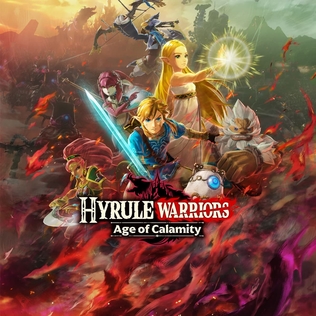 Age of Calamity (2020) Age of Calamity (2020) | 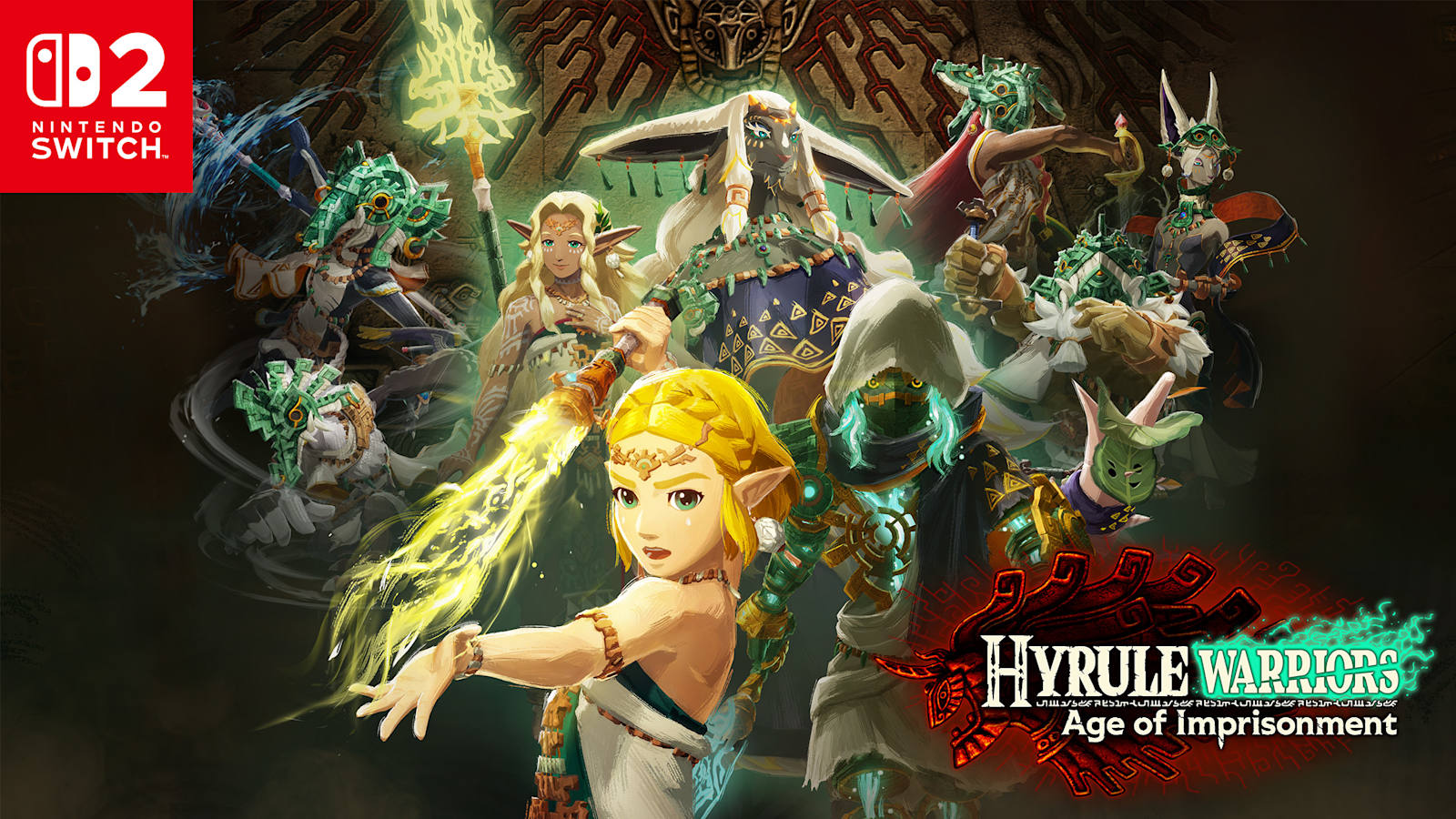 Age of Imprisonment (2025) Age of Imprisonment (2025) |
Hyrule Warriors: Age of Calamity (2020) depicts the Great Calamity — the Champions' battle against Ganon 100 years before Breath of the Wild — but tells it as an alternate history, implying its ending diverges from what Breath of the Wild's flashbacks establish actually happened. A full-text search of Zelda Wiki's official-chart-tracking Timeline page turns up zero references to Age of Calamity anywhere; it is not merely unplaced, it is entirely absent from the last chart Nintendo published (2017), which predates the game by three years and has not been revised since.
A note on scope, in the interest of accuracy: this project's original research brief assumed the community treats Age of Calamity's divergence as directly analogous to the Ocarina of Time split — a distinct, well-documented "branch point" the fandom argues about the way it argues about Child vs. Adult vs. Downfall. That specific framing did not survive this research pass as an independently verified claim; forum searches did not surface it as an established, citable community position, as distinct from being a reasonable reading of the game's own premise. Treat Age of Calamity's branch placement on this site's timeline diagram as this project's own storytelling interpretation, not a confirmed fan consensus or developer statement.
Hyrule Warriors: Age of Imprisonment shipped November 6, 2025 for Nintendo Switch 2 — notably, not a 2026 title, correcting an assumption in this project's own initial planning. It depicts the ancient Imprisoning War and Zonai-era history that precedes Tears of the Kingdom, delivered through roughly three hours of voice-acted cutscenes Nintendo has called a "canonical tale." Even so, neither its marketing nor its reviews state a formal chart placement relative to Tears of the Kingdom or the rest of the timeline — its status as a "prequel" is inferred from its subject matter and Nintendo's own framing, not confirmed on any published chart. Eiji Aonuma has separately suggested in interviews that the game's take on the Imprisoning War could inspire the next mainline Zelda title, which is itself telling: Nintendo is treating this era as live creative territory, not settled history.
Placement confidence summary
| Title | Canonicity | Placement confidence | Basis |
|---|---|---|---|
| Breath of the Wild / Tears of the Kingdom | Canon | Official (for "after all three branches"); deliberately unspecified beyond that | Aonuma/Fujibayashi, Famitsu interview |
| Hyrule Warriors: Age of Calamity | Semi-canon | Speculative | Absent from every official chart; this site's branch placement is an interpretive choice |
| Hyrule Warriors: Age of Imprisonment | Semi-canon | Speculative | Marketed/reviewed as a prequel; no chart confirms it |
6. The Philips CD-i games: unambiguously non-canon
 Link: The Faces of Evil (1993) — infamous today mostly for its animated cutscenes.
Three Zelda games were made for the Philips CD-i in the 1990s — Link: The Faces of Evil, Zelda: The Wand of Gamelon, and Zelda's Adventure — as the byproduct of a failed hardware partnership. When Nintendo and Philips' plans for a Nintendo-branded CD-ROM add-on collapsed, part of the settlement let Philips license Zelda characters for its own CD-i console. Nintendo's involvement reportedly extended only to approving character art; it had no hand in development. Series producer Eiji Aonuma has stated on record (in a 2013 interview, reproduced by Nintendo Life among others) that he doesn't think these games "really fit in the Zelda franchise." They have never appeared on any official timeline chart, and their non-canon status is about as close to formally confirmed as anything in this research.
Sources
- Zelda Wiki: Zelda Timeline
- Dexerto: Fallen Hero, Child and Adult timelines explained
- Zelda Archive (Fandom): Timeline
- Zelda Dungeon: Timeline
- Digital Trends: Zelda games in order
- CBR: Zelda Timeline and the Triforce connection
- Wikipedia: The Legend of Zelda CD-i games
- Wikipedia: Link: The Faces of Evil and Zelda: The Wand of Gamelon
- Nintendo Life: "Age of Imprisonment Could Inspire the Next Zelda Game," Say Devs
- Zelda Universe: Age of Imprisonment could inspire next Zelda game, says Eiji Aonuma
- Zelda Universe: Aonuma and Fujibayashi discuss their thoughts on the Zelda timeline
A note on method
This paper's claims were produced by a research process that fanned out multiple independent web searches, fetched primary and secondary sources, and put every extracted claim through a three-vote adversarial verification pass (each claim needed to survive at least two of three independent attempts to refute it). Several claims that seemed plausible on first pass were killed by this process — including an early draft claim that Echoes of Wisdom belongs on the Downfall Timeline chart (unverified; excluded here) and a claim that the CD-i games' absence from Hyrule Historia alone "confirms" their non-canon status (the confirmation instead rests on Aonuma's direct statement, not merely an omission). Where a finding rests on a narrower or split verification vote, that's noted inline above.